The Long Traverse

95 kilometres on the GR11 from Plànoles to Albanyà. Five consecutive days of high mountain terrain, carrying everything — one night in a mountain refuge, four in hand-picked village hostals and hotels. This is the full version.

7 days ~95km 5 hiking days 5 nights on route June – September Max 6 £2,200£1,500 pp

Founding expedition price. Full price thereafter.

Arrive in Plànoles. Walk to Albanyà. Five days of carrying everything you need.

By day three, something changes. The world narrows to the trail, the weather, the group, and the next few kilometres. The distance from anything familiar becomes tangible — and that distance is exactly the point. The Long Traverse is not a walking holiday. You carry everything. The terrain is serious. But each evening ends somewhere worth arriving: a mountain refuge at 2,000m, a Michelin-starred dinner in Setcases, a medieval village hostal in Beget. The contrast is not accidental. It is the point.

Duration 7 days
Hiking days 5 days
Distance ~95km
Nights on route 5 nights
Season June – September
Fitness Strenuous
Group size Max 6
Price £2,200£1,500 pp Founding expedition price. Full price thereafter.
Day 1

Arrive in Plànoles

By train from Barcelona or Girona, the train to Plànoles takes around two hours. The evening is for settling in, meeting the group, and going through kit and the full route plan. An early night — the hardest day of the traverse starts tomorrow.

Night 1 Plànoles Can Gasparó Hotel Rural & Restaurant — gastronomic boutique hotel in the village. Dinner at the hotel restaurant.
Day 2

Plànoles to Coma de Vaca

Strenuous GR11 · Stage 38
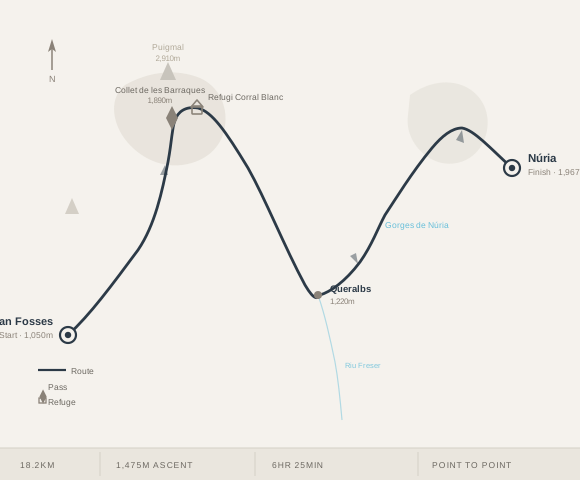
Distance 18.2km
Ascent 1,475m
Descent 770m
Time 6hr 25
High point 1,983m Creu d'en Riba
Route map: Plànoles to Núria, GR11 Stage 38

The traverse starts hard. From the valley floor at Plànoles, the GR11 climbs steeply to the Collet de les Barraques — 1,475m of total ascent through the day. It is the right way to begin: no gentle warm-up, no false start. Refugi Corral Blanc sits just below the high point, a good place to stop before the descent into Queralbs.

The route drops to Queralbs, passes below Núria, and continues east to Coma de Vaca — a remote high valley at 1,995m where the refuge sits beside the headwaters of the Ter. There is nothing here but mountain and silence. Camping is not permitted in the Queralbs Municipal Area; the refuge is the only option, and the only one you need.

Night 2 Coma de Vaca Refugi Coma de Vaca — mountain refuge at 1,995m. Half board included. Accessible only on foot.
Day 3

Coma de Vaca to Setcases

Strenuous GR11 · Stage 39
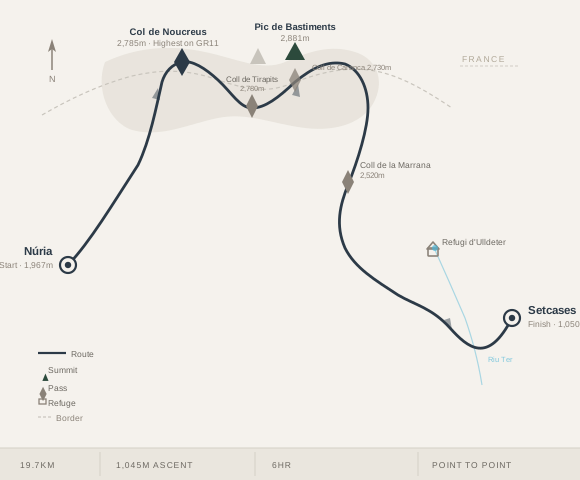
Distance 19.7km
Ascent 1,045m
Descent 1,745m
Time 6hr
High point 2,785m Col de Noucreus · Highest on GR11
Route map: Núria to Setcases, GR11 Stage 39

The stage that earns the route its reputation. Departing Coma de Vaca, the GR11 climbs the border ridge to reach Col de Noucreus at 2,785m — the highest point on the entire 820-kilometre GR11. The ridge is exposed and demands an early start; afternoon thunderstorms are a real risk in summer. Make the col before midday if there is any weather uncertainty.

The views from the col are extraordinary in both directions. The long descent via Coll de la Marrana and Refugi d'Ulldeter — familiar territory to anyone who has done the Valley Base expedition — arrives in Setcases with 1,745m of descent completed and two days of the traverse behind you.

Early start essential. The border ridge is fully exposed above 2,500m. Make the col before midday if weather is uncertain.
Night 3 Setcases Hostal La Cabanya — dinner at Can Jepet (Michelin-starred), one of the finest restaurants in the Pyrenees.
Day 4

Setcases to Beget

Moderate GR11 · Stage 40
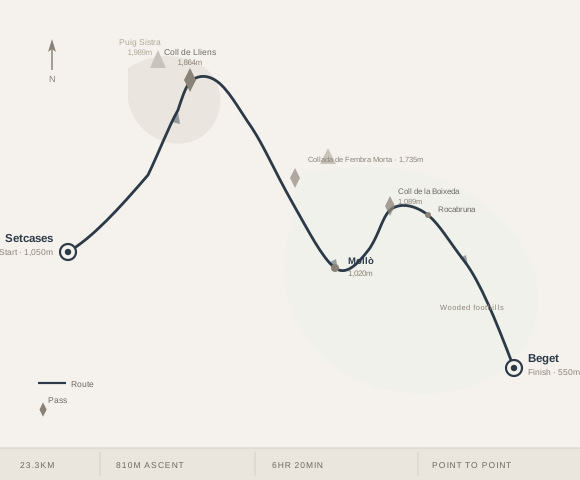
Distance 23.3km
Ascent 810m
Descent 1,535m
Time 6hr 20
High point 1,864m Coll de Lliens
Route map: Setcases to Beget, GR11 Stage 40

The GR11 leaves the high mountains behind on Day 4 and enters a different world: steep wooded foothills approaching the Mediterranean. One final climb to the Coll de Lliens (1,864m) — a last look at the high country before the route descends through increasingly warm forest to Beget.

The route passes through Mollò, a mid-stage village with a chance to stop before the final kilometres to Beget — a medieval village set deep in a limestone river valley at 550m. One of the most beautiful villages in Catalonia, and one of the most welcome sights on the route. The limestone paths into the village can be very slippery when wet.

Hot, dry conditions are likely at lower altitude. Wildfire risk is real in this section — take particular care with anything that could ignite in dry woodland.
Night 4 Beget Hostal El Forn de Beget — dinner and breakfast included on site. Can Jeroni, Beget's celebrated restaurant, is a short walk if open on the evening.
Day 5

Beget to Oix

Easy GR11 · Stage 41
Distance ~14km
Ascent ~600m
Descent ~400m
Time ~3hr 30
High point ~760m Talaixà
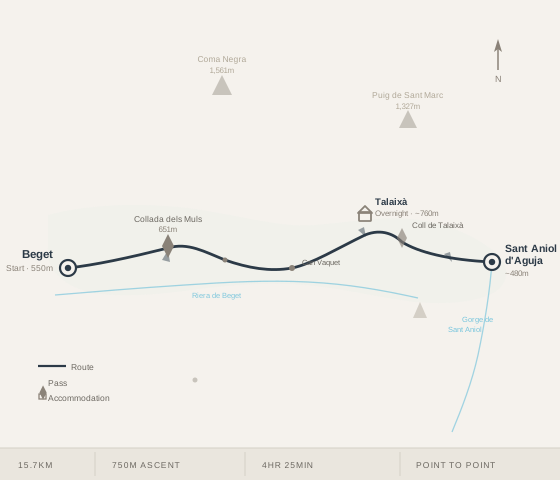
Route map: Beget to Oix, GR11 Stage 41

After four substantial days, Day 5 is the gentlest of the traverse — a shorter stage through limestone valley country that follows the Riera de Beget eastward. The Collada dels Muls (651m) is the only real climb before the route descends through the Alta Garrotxa into the village of Oix.

The terrain here shifts from high mountain to ancient woodland and stone-walled farmland. The pace drops. The village of Oix, set in the hills of the Alta Garrotxa, is a fitting place to spend the penultimate night — quiet, unhurried, and a world apart from the high ridges of Days 2 and 3.

Night 5 Oix Hostal de la Rovira — a restored stone hostal dating from 1500, with its own restaurant serving Catalan cuisine. Dinner and breakfast included.
Day 6

Oix to Albanyà

Moderate GR11 · Stage 42
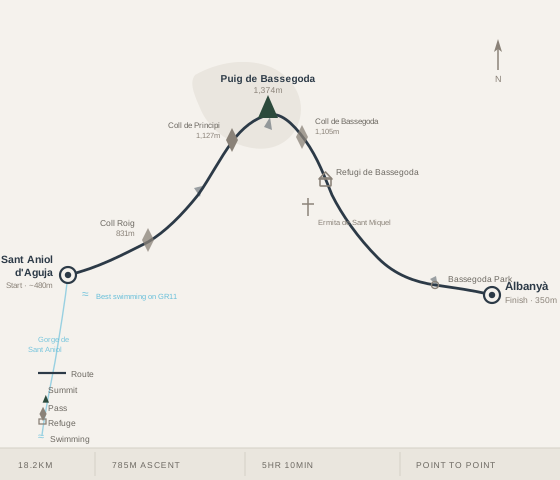
Distance ~20km
Ascent ~850m
Descent ~1,065m
Time ~5hr 30
High point 1,374m Puig de Bassegoda
Route map: Oix to Albanyà, GR11 Stage 42

The final day. From Oix the route passes the ancient monastery at Sant Aniol d'Aguja before climbing steeply through limestone country to the Puig de Bassegoda (1,374m). It is the last significant summit of the traverse — modest by the standards of Days 2 and 3, but earned. The descent to Albanyà is long, sustained, and satisfying.

The guidebook notes this stage has the two best swimming holes on the entire GR11, both a few minutes off the trail near Sant Aniol. The limestone gorge of the Riera de Sant Aniol, carved deep into the rock, is the reason so many people walk up from Sadernes. It makes a fitting final stretch. Albanyà, at 350m, marks the end. The distance from Plànoles — in metres, in days, in effort — is tangible from here.

Night 6 Albanyà La Rectoria d'Albanyà — on the main square, mountain-facing terrace, excellent food. The Long Traverse is timed to finish on a Saturday evening, which means one further option: the Observatori Astronòmic d'Albanyà runs dark-sky telescope sessions on Friday and Saturday nights. A fitting end to the week.
Day 7

Return from Albanyà

Departure day. Return to Girona or Barcelona takes approximately two hours by road — straightforward from Albanyà. Those who stayed for the Saturday night telescope session at the Observatori Astronòmic d'Albanyà will have earned a slower Sunday morning before travelling.

Inclusions

Included

  • Professional mountain guide throughout (max 6)
  • Night 1 — Can Gasparó Hotel Rural, Plànoles (B&B + dinner)
  • Night 2 — Refugi Coma de Vaca (half board)
  • Night 3 — Hostal La Cabanya, Setcases — dinner at Can Jepet (Michelin-starred)
  • Night 4 — Hostal El Forn de Beget (half board)
  • Night 5 — Hostal de la Rovira, Oix (half board)
  • Night 6 — La Rectoria d'Albanyà (B&B + dinner)
  • Pre-expedition consultation — routes, kit, fitness
  • Emergency equipment throughout (first aid, group shelter, communications)
  • Weather monitoring and contingency planning
  • Post-expedition debrief

Not included

  • Travel to Plànoles and from Albanyà
  • Lunches (provisions available at stops along the route — each participant is responsible for their own day pack)
  • Personal kit and equipment
  • Personal travel insurance (mountain rescue cover required)
  • Drinks with meals

Accommodation and restaurants are confirmed subject to availability. Where any option is unavailable, an appropriate alternative of equivalent standard will be arranged.

This is a serious undertaking

The Long Traverse requires genuine fitness. Five consecutive hiking days with a loaded pack, including two strenuous days crossing the highest terrain on the GR11. You need to arrive prepared.


What good preparation looks like: Regular multi-day hiking with a loaded pack in the months before departure. Comfortable at 20km+ days on mountain terrain. At least one multi-day backpacking trip completed in the twelve months prior. No significant knee, ankle or back issues.


Jason works through preparation with every participant in advance — the pre-expedition consultation covers fitness, kit, and expectations. If the Long Traverse isn't the right starting point, The Traverse or The Valley Base might be.

Getting there and back

Plànoles: On the Barcelona–Puigcerdà train line (Ribes de Freser connection). Approximately 2 hours from Barcelona. The expedition begins here on Day 1.


Albanyà: The finish point. Bassegoda Park is well-served for onward transport. Return to Girona or Barcelona takes approximately 2 hours by road. Logistics confirmed at pre-expedition briefing.


Accommodation: All on-route accommodation is booked in advance by Pirialta — Coma de Vaca refuge, Setcases, Beget, Oix, and Albanyà. Evening meals are included at every stop. Lunch is carried each day — provisions are available at villages along the route.

Ready to talk about the Long Traverse?

A 30-minute call is the right starting point. We'll cover fitness, timing, kit, and whether this is the right expedition for you.